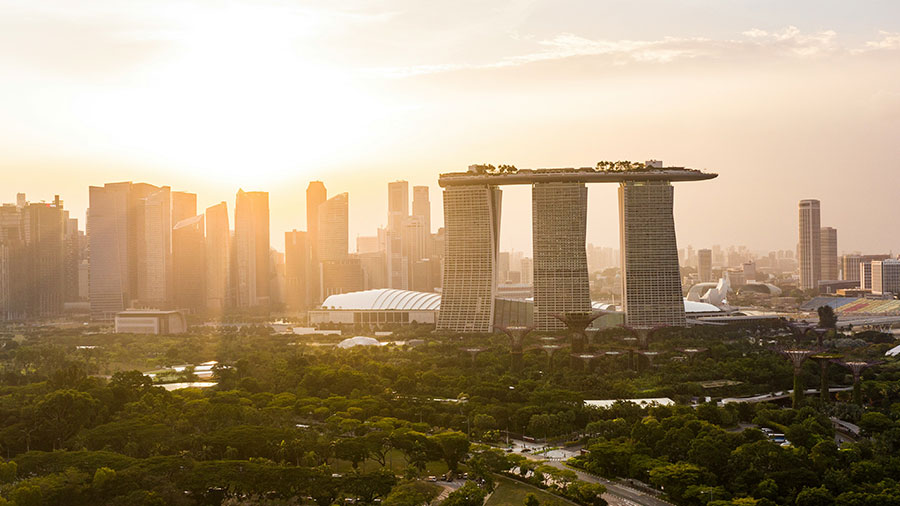


Singapore is one of the fastest jurisdictions in Asia to enter. A private limited company can be incorporated within a day of name approval, foreign ownership is unrestricted in most sectors, and the headline corporate tax rate has held at 17 percent since 2010. For EU, UK, and US investors comparing entry options across ASEAN, that combination is a genuine competitive advantage over markets where licensing, capital, and ownership restrictions can stretch setup to several months.
The registration decision is quick; the consequences are not. A representative office cannot invoice a customer, and companies that establish one and then win business earlier than expected face an unplanned migration to a full entity. A branch office keeps the parent company legally exposed and sits outside most resident-company tax incentives. Neither problem is visible at the point of registration, both surface six to eighteen months later, when unwinding the structure costs more than getting it right would have.
This guide sets out what each structure permits, how they compare the criteria that matter commercially, and where the compliance obligations sit after incorporation.
Which entity structures can foreign investors use in Singapore?
Four structures cover almost every foreign investor scenario. The right one depends less on company size than on what you intend to do commercially in the next 24 months.
Private limited company (subsidiary)
The default for foreign investors intending to trade, contract, invoice, or hire in Singapore. It is a separate legal entity, shields the foreign parent from liability, and is eligible for Singapore's resident-company tax incentives and double tax agreement network. Foreign shareholders may hold 100 percent of the shares in most sectors, and minimum paid-up capital is S$1.
Best for: companies with confirmed revenue intent, a regional headquarters plan, or a need to hire locally.
Branch office
a registered extension of the foreign parent, not a separate legal entity. The parent remains liable for the branch's obligations, and the branch is generally taxed as a non-resident, which places most resident-company exemptions and treaty benefits out of reach. It must appoint at least one authorised representative ordinarily resident in Singapore and file both its own accounts and the parent's.
Best for: regulated sectors or group policies that require the parent's balance sheet to sit behind Singapore operations; rarely the optimal choice on tax grounds alone.
Representative office (RO)
a temporary, non-commercial presence registered with Enterprise Singapore for market research, liaison, and feasibility work. It cannot conclude contracts, invoice, or generate revenue. Eligibility is restricted: the foreign parent must have been established for at least three years with sales turnover above US$250,000, and RO headcount is capped at fewer than five staff. An RO is valid for one year, renewed annually, to a maximum of three years , after which it must convert or close.
Best for: genuine pre-commitment market testing where no revenue will be earned during the assessment period.
Variable capital company (VCC)
a fund vehicle, not a trading structure, used for private equity, hedge, venture, real estate, and family office funds. It can operate standalone or as an umbrella with ring-fenced sub-funds, and must appoint a fund manager licensed, registered, or exempted by the Monetary Authority of Singapore. More than a thousand VCCs have been registered since the framework launched in 2020.
Best for: fund managers domiciling in Asia, not operating companies. See our dedicated guide to the Variable Capital Company in Singapore for structuring detail.
How do the four structures compare?
|
Criterion |
Private limited company |
Branch office |
Representative office |
VCC |
|
Separate legal entity |
Yes |
No , extension of parent |
No |
Yes |
|
Foreign ownership |
100% permitted in most sectors |
100% (wholly owned by parent) |
N/A , not an ownership vehicle |
100%, subject to fund manager requirement |
|
Permitted activities |
Full commercial activity |
Same scope as parent |
Research and liaison only , no revenue |
Collective investment only |
|
Liability |
Limited to share capital |
Parent fully liable |
Parent fully liable |
Ring-fenced by sub-fund |
|
Minimum capital |
S$1 |
None prescribed |
None , funded by parent |
Equal to net asset value |
|
Tax treatment |
17% resident rate; access to exemptions and DTAs |
Generally taxed as non-resident; limited incentive access |
Not taxable , no income |
13O/13U incentives available if qualifying |
|
Local appointment required |
≥1 director ordinarily resident in Singapore |
≥1 authorised representative ordinarily resident |
Chief representative from parent |
≥1 director ordinarily resident |
|
Typical setup time |
1–3 days once KYC and documents are ready |
1–2 weeks |
1–2 weeks |
4–8 weeks including manager arrangements |
|
Duration limit |
None |
None |
3 years maximum |
None |
For a deeper structural comparison, see Private Company vs Branch Office vs Representative Office in Singapore.
What does it take to keep an entity compliant?
Registration is the cheap part. ACRA charges S$15 for a name application and S$300 for incorporation. The recurring obligations are where cost and risk concentrate.
What must be in place from day one or shortly after:
- At least one director ordinarily resident in Singapore, a Singapore citizen, permanent resident, or an Employment Pass holder attached to the company
- A company secretary appointed within six months of incorporation
- A registered office address in Singapore, accessible to the public during prescribed hours
- A register of registrable controllers (RORC), which from 16 June 2025 must be maintained from the date of incorporation, with no grace period, and lodged with ACRA's central register
What follows on the tax and filing side:
- Corporate income tax at 17 percent, with start-up and partial exemptions materially reducing the effective rate for most new companies
- GST registration once taxable turnover exceeds S$1 million over any 12-month period; the current rate is 9 percent
- Statutory audit unless the company qualifies as a "small company”, meeting two of three tests: revenue and total assets each not exceeding S$10 million, and no more than 50 employees
- Annual return filing with ACRA and annual corporate tax filing with IRAS
What changed recently and is routinely missed: the Corporate Service Providers Act 2024 and related amendments, in force since mid-2025, tightened the rules around nominee arrangements considerably. Nominee director appointments made by way of business must now be arranged through an ACRA-registered corporate service provider, nominee director and nominee shareholder information must be filed with ACRA's central registers, and controller information must be verified annually. Penalties for register-related offences run to S$25,000. Foreign investors relying on a nominee resident director, a common arrangement where no shareholder holds Singapore residency, should treat this as a structural compliance item, not an administrative one. Our advisors can review existing arrangements against the current framework.
Where do foreign investors most often get this wrong?
The recurring errors are commercial, not technical:
- Using an RO as a soft launch, then trading through it. The moment a contract is signed or an invoice issued, the structure is wrong. Converting mid-deal delays revenue recognition and creates a tax exposure question.
- Choosing a branch for perceived simplicity. A branch is not simpler to run, exposes the parent, and generally forfeits access to resident-company exemptions. Groups often default to it because it mirrors their European structure, then restructure within two years.
- Budgeting only for government fees. The S$315 in ACRA fees is the smallest line item. Resident director arrangements, corporate secretarial services, registered office, accounting, and audit , where applicable , form the real first-year cost.
- Underestimating bank account opening. Corporate account approval involves substantive KYC on the ultimate beneficial owners and the business model. This is frequently the longest step in the entire process, not incorporation. See Opening a Bank Account in Singapore.
- Planning to relocate staff without checking pass thresholds. Employment Pass applicants must meet a minimum qualifying salary , S$5,600 per month in most sectors and S$6,200 in financial services, rising with age , and pass the points-based COMPASS assessment. A rejected pass for a designated country manager can stall an entire entry plan.
- Deferring IP registration. Singapore operates a first-to-file trademark system. Protection should be filed alongside, not after, incorporation. See Intellectual Property Protection in Singapore.
Where a structure has already been chosen badly, the remedy is restructuring or closure , both of which carry cost and timeline consequences. See Closing or Changing the Structure of a Company in Singapore.
Can I do business in Singapore without setting up an entity?
Sometimes. If your activity is limited to exporting to Singapore customers, appointing a distributor, or engaging contractors without a fixed local presence, an entity may not be required, though GST, withholding tax, and permanent establishment questions still apply. Where you intend to hire, contract locally, or hold a licence, an entity is unavoidable.
How does Singapore compare with other ASEAN entry options?
For investors running a parallel assessment of Indonesia, Vietnam, or Malaysia, Singapore's advantages are speed, ownership certainty, and predictable compliance rather than operating cost , labour and premises are materially more expensive. Where Indonesia's PT PMA typically takes months and carries minimum investment thresholds, Singapore's incorporation is measured in days with no capital floor. Many groups resolve this by holding regional operating entities under a Singapore parent, using the treaty network and holding-company regime while keeping cost-sensitive operations elsewhere in ASEAN.
Where does professional advice change the outcome?
Incorporation itself can be handled by any registered filing agent. Advisory input matters at four specific points:
- Structure selection, matching entity type to a 24-month commercial plan, including whether Singapore should hold regional subsidiaries
- Tax positioning, exemption eligibility, treaty access, transfer pricing where the Singapore entity transacts with the parent, and substance requirements
- Compliance architecture, corporate secretarial, controller and nominee registers, GST and e-invoicing readiness, and audit exposure
- Post-incorporation execution, banking, payroll and employment pass planning, and IP protection
Dezan Shira & Associates supports foreign investors across corporate establishment, business advisory, and market intelligence , including entity selection, tax and accounting compliance, payroll, and restructuring.
What are the next practical steps?
- Define commercial intent for the next 24 months. Will you invoice from Singapore? Hire? Hold regional subsidiaries? The answer determines the structure.
- Confirm sector-specific licensing and ownership conditions. Financial services, education, and select regulated activities carry additional requirements.
- Resolve the resident director question early. This is the most common structural blocker for foreign-owned companies and now sits inside a tighter regulatory framework.
- Model first-year cost properly , including secretarial, accounting, banking, and pass-related costs, not just government fees.
- Sequence banking and pass applications alongside incorporation, not after it.
- Take advice before registering, not after. Restructuring costs consistently exceed the cost of getting the structure right at the outset.
FAQs: Setting up a Business in Singapore
What are the steps to open a bank account in Singapore?
As a financial hub in Southeast Asia, Singapore hosts a variety of local and foreign financial institutions. As such, nearly all major foreign banks have a presence in the city-state and a Singapore-based corporate account can receive funds from any location worldwide, efficiently.
Singapore banks are set to request comprehensive information from foreign clients regarding their professional backgrounds and proposed business plans. Foreign-owned companies or individuals can expect to provide more detailed information compared to their local counterparts. The banks will conduct Know Your Customer (KYC) checks, which involve conducting thorough due diligence to verify identities and evaluate potential risks. This process may also involve identifying the ultimate beneficial owner (UBO) in corporate structures and gathering information on all intermediate corporate layers.
This is time consuming, and it will take clients several months to provide these in most cases. Banks may also request supplier, vendor and client contracts, a list of the top vendors and suppliers as well as countries and jurisdictions that the company will engage with. Most banks also have minimum account balances and minimum revenues that clients need to maintain - otherwise the account opening will be rejected. Clients should do their research and engage trusted advisors with a network of contacts in the banking sector to facilitate account openings.
How well developed is Singapore’s IP protection environment?
Singapore has one of the world’s most robust legal frameworks for intellectual property (IP). Singapore’s IP framework is comprehensive and effectively safeguards the various forms of IP – patents, trademarks, copyrights, and trade secrets. The Intellectual Property Office of Singapore (IPOS) – a statutory board under Singapore’s Ministry of Law – oversees IP protection in the country. IPOS has established a reputation for efficiency and reliability in helping businesses manage and protect their IP assets.
How difficult is it to close a business in Singapore?
To deregister a foreign company in Singapore, including a branch or representative office of a foreign company, the company must notify the Singapore Accounting and Corporate Regulatory Authority (ACRA) within seven days of ceasing business operations.
The procedures for closing a foreign company in Singapore can be done online through ACRA’s official business filing portal, BizFile. A Singapore personal access password (SingPass) is required to log in to the portal.
- The procedure to do so is as follows:
- Notification of cessation of business
- Settling outstanding tax matters and liabilities
- Cancelling registration for goods and service tax
- Application for striking off
- Notice by authorized foreign company representative of liquidation or dissolution of company