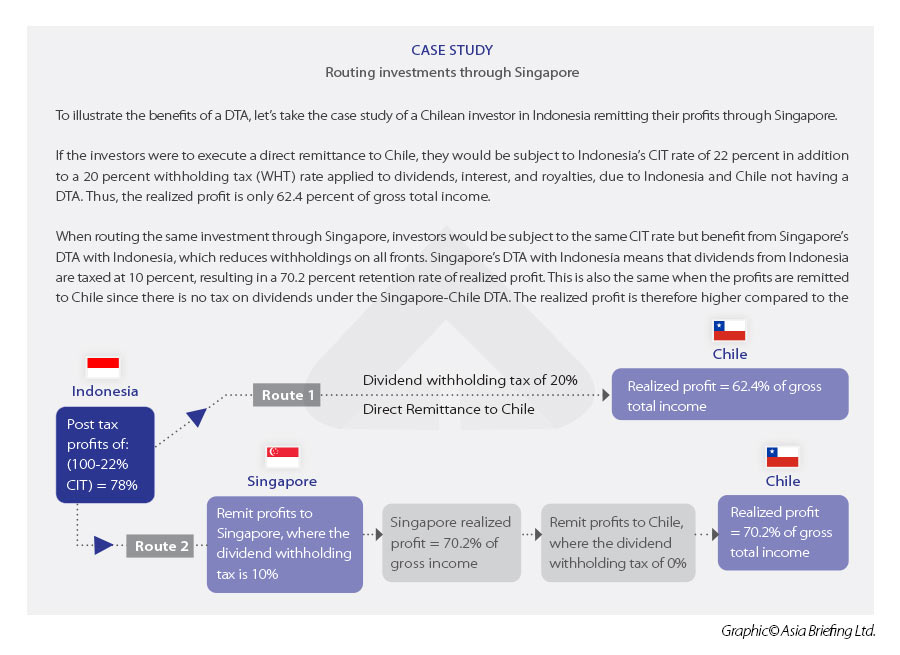


Singapore has one of the world’s most extensive double taxation agreement (DTA) networks, attracting international businesses from a multitude of conventional and nuanced industries. DTAs eliminate instances of double taxation from cross-border activities, such as trade, knowledge sharing, as well as investments between two countries.
Foreign investors should seek the help of registered tax advisors to better understand how they can benefit from Singapore’s vast DTA network.
List of countries with comprehensive DTAAs
| Country/Region | Country/Region | Country/Region | Country/Region |
|---|---|---|---|
| Albania | Denmark | Kyrgyz Republic | Romania |
| Armenia | Ecuador | Laos | Rwanda |
| Australia | Egypt | Latvia | San Marino |
| Austria | Estonia | Lebanon | Saudi Arabia |
| Bahrain | Ethiopia | Libya | Serbia |
| Bangladesh | Fiji | Lichtenstein | Seychelles |
| Barbados | Finland | Lithuania | Slovak Republic |
| Belarus | France | Luxembourg | Slovenia |
| Belgium | Gabon | Malta | South Africa |
| Bermuda | Georgia | Mauritius | Spain |
| Brazil | Germany | Morocco | Sri Lanka |
| Brunei | Ghana | Panama | Sweden |
| Bulgaria | Greece | Pakistan | Switzerland |
| Cabo Verde | Guernsey | Papua New Guinea | Taiwan |
| Cambodia | Hong Kong | Philippines | Thailand |
| Canada | Hungary | Poland | Tunisia |
| Chile | India | Portugal | Turkey |
| China | Indonesia | Qatar | Turkmenistan |
| Cyprus | Iran | Romania | Ukraine |
| Czech Republic | Ireland | Rwanda | United Arab Emirates |
| Estonia | Isle of Man | San Marino | United Kingdom |
| Fiji | Israel | Saudi Arabia | United States |
| France | Italy | Serbia | Uzbekistan |
| Gabon | Japan | Seychelles | Venezuela |
| Georgia | Jersey | Slovak Republic | Vietnam |
| Germany | Jordan | Slovenia | Zimbabwe |
| Greece | Kazakhstan | South Africa | |
| Guernsey | Korea (South) | Spain | |
| Hong Kong | Kuwait | Sri Lanka | |
| Hungary | Kyrgyz Republic | Sudan |
Income types covered under a DTA
There are several types of DTAs signed by Singapore: comprehensive, limited, and exchange of information arrangements (EOIAs).
Comprehensive DTAs provide relief from double tax for all income types between the two signatories. Limited DTAs, however, only provides relief from income generated from air transport and shipping, and EOIAs are provisions for the exchange of tax information.
The tax reliefs under each DTA treaty differs for each country. They normally cover several income types:
- Tax on royalties;
- Tax on dividends;
- Tax on capital gains;
- Tax on interests;
- Shipping and air transport;
- Directors’ fees;
- Independent and dependent personal services;
- Researchers;
- Students; and
- Income from immovable property.
Claiming relief under the DTA
To obtain the benefits of the DTA, the company must first submit its Certificate of Residence (COR) to the IRAS as evidence of a tax residency in Singapore. Only Singaporean tax residents and the tax residents of the treaty partner are recognized.
Tax residents of the treaty partner must also submit a COR certified by the tax authority of the treaty partner to the IRAS in order to obtain relief under the DTA.
Singaporean tax residents can still avoid double taxation even if Singapore does not have a DTA with a particular country through the Universal Tax Credit (UTC) scheme.
This applies to all foreign taxes paid by a Singaporean tax resident on the following income categories:
- Royalties derived from outside of Singapore;
- Foreign income from professional services or consultancy;
- Foreign-sourced dividends; and
- Foreign branch profits.
The IRAS will grant the tax exemption if the following conditions are met:
- At least 15 percent in corporate taxes (headline tax) are paid on the income sourced from the foreign jurisdiction;
- The company has been subjected to tax in the foreign jurisdiction, this can be different from the headline tax; and
- The IRAS is satisfied that granting the tax exemption will benefit the tax resident in Singapore.
How to claim tax relief under the Double Taxation Agreement (DTA)
|
Step |
Non‑resident company |
Non‑Resident Professional (consultant, trainer, coach, etc.) |
|
1. Check eligibility for Double Taxation Relief (DTR) |
|
|
|
2. Obtain supporting documents |
Certificate of Residence (COR) from foreign tax authority for each year claimed.
|
|
|
3. Submit documents to IRAS by the due date |
|
|
Determining the treatment of profits
Defining a permanent establishment (PE) is an important feature within all DTA treaties in order to determine the treatment of business profits. The PE refers to the fixed place of business through which the taxpayer carries out their business operations.
The taxation of profits falls under the country where the PE is set up unless the company opens a PE in another country. In the absence of a DTA treaty, any profits would mean the PE would bear a double tax burden for the business.
This means foreign investors who have a subsidiary company registered in Singapore can take advantage of the country’s DTAs as well as FTAs through ASEAN and Asia.
A business is deemed to have a PE if they carry out business activities lasting over 183 days in the following places:
- Offices;
- Factories;
- Warehouses;
- Farm or plantation;
- Construction or installation site
- Mines, wells, or quarries; and
- Workshops.