Other Briefings
Timor-Leste Joins ASEAN — A New Frontier for Strategic Investors
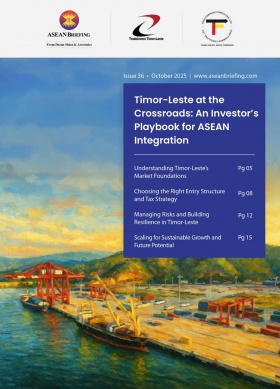
On October 26, 2025, Timor-Leste became the 11th member of ASEAN, completing a process that began with its observer status in 2022. The milestone integrates the country into Southeast Asia’s main trade and policy framework and marks its transition from a frontier economy into a legitimate participant in regional value chains.

For foreign investors, this change introduces predictability, opens access to ASEAN mechanisms, and creates a clear legal basis for regional operations.
What ASEAN membership changes
Accession brings Timor-Leste into the ASEAN Economic Community and the ASEAN Free Trade Area, which gradually removes tariff and non-tariff barriers. The government has strengthened TradeInvest Timor-Leste, its investment-promotion agency, and SERVE, the one-stop registry that handles incorporation. Both agencies now coordinate issuance of Investment Certificates, which secure income-tax holidays, customs exemptions, and import-duty relief.

These reforms parallel Cambodia and Laos in their early ASEAN years, where institutional modernization followed membership and attracted long-term foreign investment. Timor-Leste is pursuing the same path by modernizing its investment law, digitizing customs, and connecting infrastructure to regional supply chains.
Market scale and operating conditions
Timor-Leste has a population of about 1.4 million and a GDP of roughly US$2 billion. Although the domestic market is small, the economy uses the US dollar as legal tender, eliminating exchange-rate risk. The investment law guarantees free repatriation of profits and dividends through local banks. These fundamentals—hard-currency stability and repatriation rights—make the jurisdiction attractive for international investors who value predictable treasury and exit mechanics.
Entry pathways
Foreign investors register through SERVE for incorporation and apply to TradeInvest for certification. TradeInvest targets decisions within several weeks, with published timelines ranging from about 18 working days for incentives processing to around 30 days for final investment approval, while company registration usually completes within 5 days. Certified enterprises can import capital goods duty-free and obtain income-tax exemptions linked to location and project size. This process provides a functioning legal route for establishing and operating foreign-owned companies while ASEAN harmonization proceeds.
Tax environment
Corporate income tax for non-petroleum activities stands at 10 percent. There is no domestic VAT, while imports attract a 2.5 percent sales tax and a 5 percent customs duty. Withholding tax applies to certain activities, and non-residents without a permanent establishment face a 10 percent final tax on Timor-Leste–sourced income. Double-taxation treaties remain limited, but alignment with ASEAN standards is expected to expand treaty coverage over the next few years. The current tax structure remains light, transparent, and efficient for export-oriented ventures.
Land and property structure
Foreign ownership of land is constitutionally prohibited, but investors can obtain long-term state or private leases. Leaseholds are secure, transferable, and registrable, which makes them the standard vehicle for hotels, manufacturing, and logistics projects. The state often grants concessions on public land for strategic investments, providing a workable alternative to freehold ownership.
Incentives and development zones
Investment incentives under Private Investment Law 15/2017 are among the most competitive in the region. Certified investors receive income-tax holidays of up to ten years and customs and excise exemptions on imported materials. Benefits vary by geography: Zone A covers Dili, Zone B covers other municipalities, and Zone C covers Ataúro Island and Oe-Cusse, where projects qualify for the longest incentives and land concessions. These zones correspond with national plans to diversify beyond oil dependency and to attract renewable-energy, tourism, and agribusiness projects.
Infrastructure and connectivity
The Tibar Bay Port, Timor-Leste’s first modern container terminal, opened under a public–private partnership and has replaced Dili Port as the country’s main maritime gateway. The new port improves reliability, cuts dwell time, and enables larger vessels to dock. Infrastructure upgrades are also underway in power generation, roads, and telecommunications. These developments underpin the government’s effort to make Timor-Leste part of ASEAN’s logistics network linking Indonesia and northern Australia.
Strategic investment approach
Foreign investors should plan entry as a sequenced process anchored in the Private Investment Law and its 2018 implementing decree. These frameworks define incentives, licensing, and reporting while ASEAN membership provides the broader policy environment for integration.
Most companies begin with a commercial or services presence in Dili, where TradeInvest and SERVE are based and where government ministries and the banking system operate. Early entry enables investors to obtain certification, assess logistics, and build local teams before committing major capital. Once operations stabilize, expansion into production or export activities becomes viable, especially in Oe-Cusse’s Special Economic Zone (ZEESM), which offers extended tax holidays, simplified customs, and pre-approved industrial land.
Tourism, renewable energy, and agribusiness currently provide the fastest entry tracks because they align with national investment priorities. Projects in Ataúro Island or Oe-Cusse can qualify for Zone C incentives, including income-tax exemptions of up to ten years and duty reductions on imported materials. Manufacturing can succeed when investors price in imported inputs and use improved port logistics at Tibar Bay to manage costs.
Public–private partnerships are encouraged in infrastructure, power, and education. Investors typically negotiate memoranda of understanding with the responsible ministries, supported by TradeInvest’s technical opinions. Engaging early with the Ministry of Tourism, Commerce and Industry or Electricidade de Timor-Leste often accelerates land access and utility connections, two of the most decisive factors in project implementation.
The most effective strategy combines early incorporation for legal recognition with phased capital deployment tied to infrastructure readiness. Companies that secure certification during this integration phase gain not only fiscal advantages but also priority consideration for future ASEAN-funded programs. The current window favors investors who establish a presence now while incentives and administrative bandwidth are strongest.
About Us
ASEAN Briefing is one of five regional publications under the Asia Briefing brand. It is supported by Dezan Shira & Associates, a pan-Asia, multi-disciplinary professional services firm that assists foreign investors throughout Asia, including through offices in Jakarta, Indonesia; Singapore; Hanoi, Ho Chi Minh City, and Da Nang in Vietnam; and Kuala Lumpur in Malaysia. Dezan Shira & Associates also maintains offices or has alliance partners assisting foreign investors in China, Hong Kong SAR, Mongolia, Dubai (UAE), Japan, South Korea, Nepal, The Philippines, Sri Lanka, Thailand, Italy, Germany, Bangladesh, Australia, United States, and United Kingdom and Ireland.
For a complimentary subscription to ASEAN Briefing’s content products, please click here. For support with establishing a business in ASEAN or for assistance in analyzing and entering markets, please contact the firm at asean@dezshira.com or visit our website at www.dezshira.com.
- Previous Article U.S. Tariffs in Asia 2025 – A Regional Investment Map
- Next Article Which Philippine Work Visa Best Fits Foreign Investors